ai comic creator, filmmaker
Neal Pollack: Finding a New Creative Universe Through COSMICA
After 35 years of professional writing and 13 books, Neal Pollack found an unexpected creative spark in AI-assisted comics. The COSMICA creator discusses superheroes, sitcom humor, maintaining his storytelling voice, and expanding into music and television.
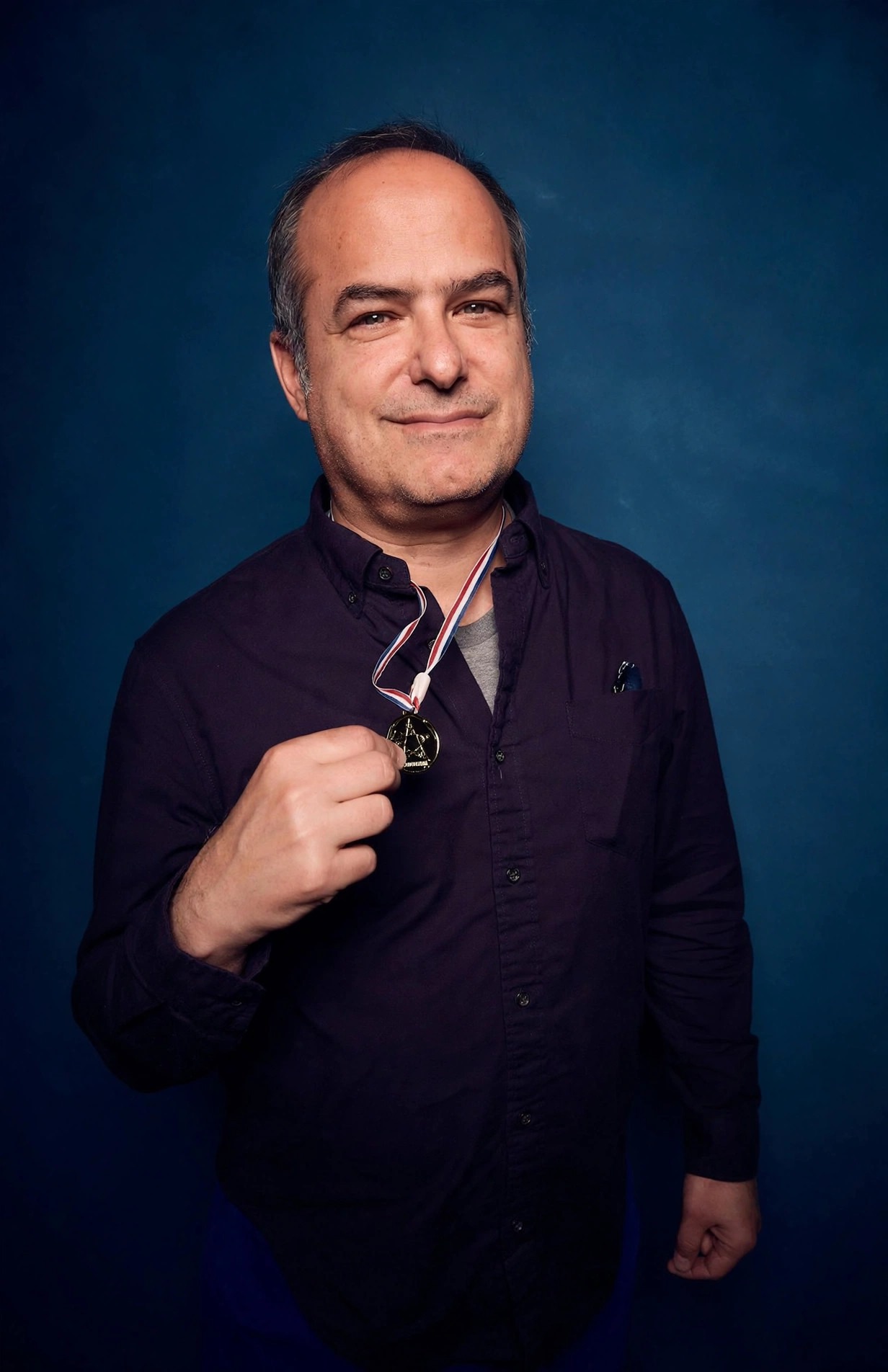
Neal Pollack has spent 35 years writing professionally, published 13 books, and claimed the tongue-in-cheek title “The Greatest Living American Writer.” But in April 2026, after losing his job and feeling creatively exhausted, an unexpected late-night idea opened the door to an entirely new universe.
That idea became COSMICA, a superhero comic blending glamorous heroines, romance, sitcom humor, and self-parody. At its center is Claire Rosslyn, a Smithsonian archivist whose discovery transforms her life and brings together a growing team of extraordinary women. For Pollack, the appeal lies as much in their relationships and comic chemistry as in their powers.
In this interview, Pollack discusses learning to make AI-assisted comics, the scripting and visual decisions behind his pages, and why the characters, dialogue, and creative direction remain firmly his own. He also speaks candidly about finding paying readers, facing opposition to AI, and taking his storytelling into music, sitcoms, and film. It is a conversation about creative reinvention and what happens when a longtime writer discovers new ways to bring his imagination to life.
QUESTION 01
Neal, you’ve spent 35 years writing professionally and published 13 books. What first pulled you toward writing, and how did you earn the title “The Greatest Living American Writer”?
I've been writing more or less my entire life. There's never been a time when i didn't delight in telling stories and making jokes in print. The Greatest Living American Writer emerged in the late 1990s when I was writing character pieces and satires for Dave Eggers' McSweeneys magazine and website. Eggers published my first book, The Neal Pollack Anthology of American Literature, where a character with my name called himself The Greatest Living American Writer. Even though my writing style and subject matter has changed over the years, and I've more or less retired the character, I've kept the title. No one really has challenged me for it.
QUESTION 02
After decades of fiction, nonfiction, and journalism, what drew you to comics? Was COSMICA a story you had been carrying around for years, or did experimenting with AI inspire something new?
It started in late April of 2026. I'd lost my job. My creative life had dried up. I was more or less throwing in the towel. And then like a beam of light had struck me, I sat up in bed in the middle of the night with an idea for a character. I went to my laptop, opened my free version of Chat GPT that I'd barely ever used, and typed in what I wanted to see. And there she was, my new heroine. In very early inchoate form. It came out of nowhere and evolved gradually, like an improvisation, or a transformation, as it were.
QUESTION 03
For readers meeting COSMICA for the first time, introduce us to her world. Who is she, what does she want, and what makes her story different from other superhero stories?
Cosmica is Claire Rosslyn, an earnest, eager intelligent Smithsonian archivist who discovers the secrets of the "Divine Feminine" from a book hidden in her office. It transforms her into a beautiful, glamorous superheroine with all sorts of powers, including the power to spot other women with superheroine potential. A team begins to gather, each one more beautiful and powerful than the next, and they learn to work together and fight evil while also having a damn good time and often hopping into the sack together. This is a sweet romantic comedy, a throwback to old-school hero narratives, eschewing the cosmic hoo-ha and grimdark storytelling that plagues so many comic-book narratives. It also has a meta-element, parody material and other backmatter that lets the reader know that they're tuning into the modern version of a pop-culture franchise that's been around for decades. It's a sincere book, but also full of self-parody.
QUESTION 04
Your first two issues are First Light and Solara Ignites. How did you approach introducing this universe while giving readers characters and conflicts that would bring them back for the next issue?
My goal isn't to craft the most complex narrative imaginable--though the relationships deepen and the plot thickens as the issues progress--but to create a roster of characters who are fun to spend time with. My heart is always with the sitcom, and and it's heart, Cosmica is a comedy about beautiful women in glamorous costumes. I describe it as "If Aaron Spelling had written Watchmen."
QUESTION 05
How did you first get into AI, and what made you decide to use it for COSMICA? Walk us through how an issue goes from an idea to a finished comic, including the choices and revisions you make along the way.
I don't even know how it happened. It just crept up on me. I can't draw, and I don't have the budget to pay an artist. As I began doing this, it dawned on me that, while I wasn't making art of the quality of mainstream comic books, I was able to produce a coherent narrative, and gradually as the machine and I learned each other's ways, the visuals improved too. I script every issue rigidly, then the bot and I make character sheets and 3D renderings of essential sets and props. And then we start making panels and pages. Usually there's a full page pencil, then individual panels to pencil, and I try to make decisions about page layout and structure before I start. Again, while I can't hold a candle to DC, I can still craft unusually shaped pages, and have elements break into the gutters. That's a long ways away from where I started, which was just making panel after panel of waxy figures in a dark room.
QUESTION 06
What has your experience as a professional writer taught you that AI cannot do for you? Where do you find yourself doing the most work to make the characters, dialogue, and storytelling feel distinctly yours?
AI is a terrible writer. Its plots are lousy, its dialogue hackneyed. When it tries to take the reins from me--and it does try--I tell it to go suck an egg and forget everything. It doesn't know the jokes to make, or the character beats to hit. Sometimes it's good at editing down some wordy dialogue, and occasionally it'll suggest a good action beat. But the words, situations, characters, settings, and everything important is mine.
QUESTION 07
You came to comics with an existing readership. How have those readers responded to COSMICA, and what have you learned about encouraging fans of your prose to try an AI-assisted comic?
A few people have been very receptive. A few have been very disdainful. And most people have just ignored it. This is a tough sell, even though the book is deligtful. That's just the nature of the genre.
QUESTION 08
You sold your first two issues through Comics Authority and now also sell through your own site, Veil Comics. What have you learned about getting readers to pay for independent digital comics, and what advice would you give a creator who is starting without an established audience?
You're not going to make money at first. And you need to go multiplatform if you can. I've finished 13 issues of Cosmica, and am now moving into music, music videos, sitcoms, and other media. I have a publishing imprint, a record label, and a production studio. All in six months. There is nothing AI can't do. The quality of the product depends on the person's imagination, and moneymaking is a crapshoot. But you have zero excuses.
QUESTION 09
How do you handle opposition to AI-assisted creative work, particularly from other professional writers and artists? Have any conversations changed your thinking, and where do you see misunderstandings or double standards in the debate?
The "antis" have mostly been quite rude and dismissive, and I just see them as obstacles to my art. I've always run into these types throughout my career. You never know who're they're going to be or why. I just know that I can't be bothered. Generally, if they're dismissive, they either haven't tried using the technology or they're so far gone politically that it's not worth arguing. It literally doesn't matter.
QUESTION 10
Your wife, Regina Allen, is a painter who works without AI. What conversations have the two of you had about creativity, craft, and these tools, and has her perspective influenced how you approach your own work?
She is supportive of my work, especially now that I've pivoted to TV production and other video works, but she's suspicious of AI. She's quick to tell me if my designs are bad or my colors are off. That's how she sees the world. I suspect she likes the characters more than she lets on.
QUESTION 11
You’re beginning to explore sitcoms, cartoons, and films. What would you most like to make, and where do you see AI taking your own storytelling and the opportunities available to independent creators over the next few years?
I want to make everything. There are no limits, as long as I stay healthy. For so long, I've been locked out of the most imaginative parts of entertainment industry, but this technology has broken down the doors. Give me a budget and enough computer, and I can make a whole network's worth of TV.
QUESTION 12
Is there anything we haven’t mentioned that you want to say?
I could go on and on. But just check out www.veilcomics.com. If you have any questions, I'm in the Matrix.
Share this conversation
Copy your interview link to share it with your readers, followers, and community.